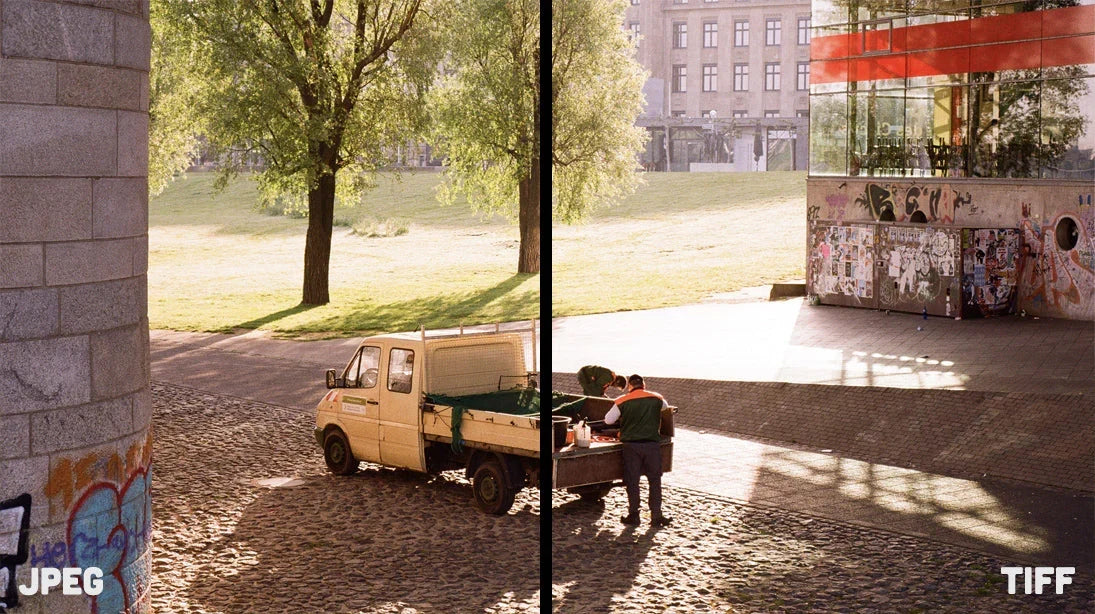
If you’ve ever had film developed and scanned, you’ve probably seen the option for:
JPEG or TIFF.
And if you’re new to film photography, it can feel a bit confusing straight away.
One sounds familiar.
One sounds expensive.
So what’s the actual difference?
The Short Version
JPEG =
Smaller file size.
Easy to share.
Great for everyday use.
TIFF =
Much larger file size.
More image data.
Better for editing and printing.
That’s really the core difference.
But here’s what that actually means in practice.
What Is A JPEG Scan?
JPEG is the standard image format most people use every day.
Your phone uses JPEGs.
Instagram uses JPEGs.
Most websites use JPEGs.
When your film is scanned as a JPEG:
- The file is compressed
- File sizes stay smaller
- Images are easier to store and send
For most people, JPEG scans are completely fine.
Especially if you:
- Share photos online
- Post to Instagram
- Keep digital memories
- Don’t heavily edit your images
JPEG scans also usually process faster because the files are lighter overall.
What Is A TIFF Scan?
TIFF files contain significantly more image information.
That means:
- More detail
- Better colour flexibility
- More editing headroom
- Better for professional printing
TIFF scans are designed more for photographers who want to edit their images properly afterward.
Especially if you:
- Use Lightroom or Photoshop
- Print large images
- Professionally archive work
- Need maximum detail retention
The trade-off?
The files are huge.
A single TIFF scan can be dramatically larger than a JPEG.
Can You See The Difference?
Sometimes yes.
Sometimes no.
Straight out of the scanner, the average person might not immediately notice a huge difference between a JPEG and TIFF.
Where TIFF really matters is during editing.
If you heavily adjust:
- Exposure
- Shadows
- Highlights
- Colour balance
TIFF files generally hold together better.
JPEG files can start breaking apart faster because they contain less image data.
So Which Should You Choose?
For most people shooting film casually:
JPEG is more than enough.
It keeps things simple.
Storage stays manageable.
Sharing is easy.
If you’re shooting professionally, printing large, or editing heavily:
TIFF is worth considering.
A lot of photographers also do both:
JPEG for quick access.
TIFF for archive purposes.
Our Honest Advice
Don’t get too caught up in file formats early on.
A good photo is still a good photo.
The most important thing is:
- Getting comfortable shooting
- Understanding light
- Learning your camera
- Actually finishing rolls
The technical side can always come later.
WHAT FILM SHOULD I SHOOT? A BEGINNER’S GUIDE TO 35MM FILM STOCKS
FIRST ROLL? START HERE